How La Alpujarra Inspired Heat of Desire
Written by Summer Sinclair
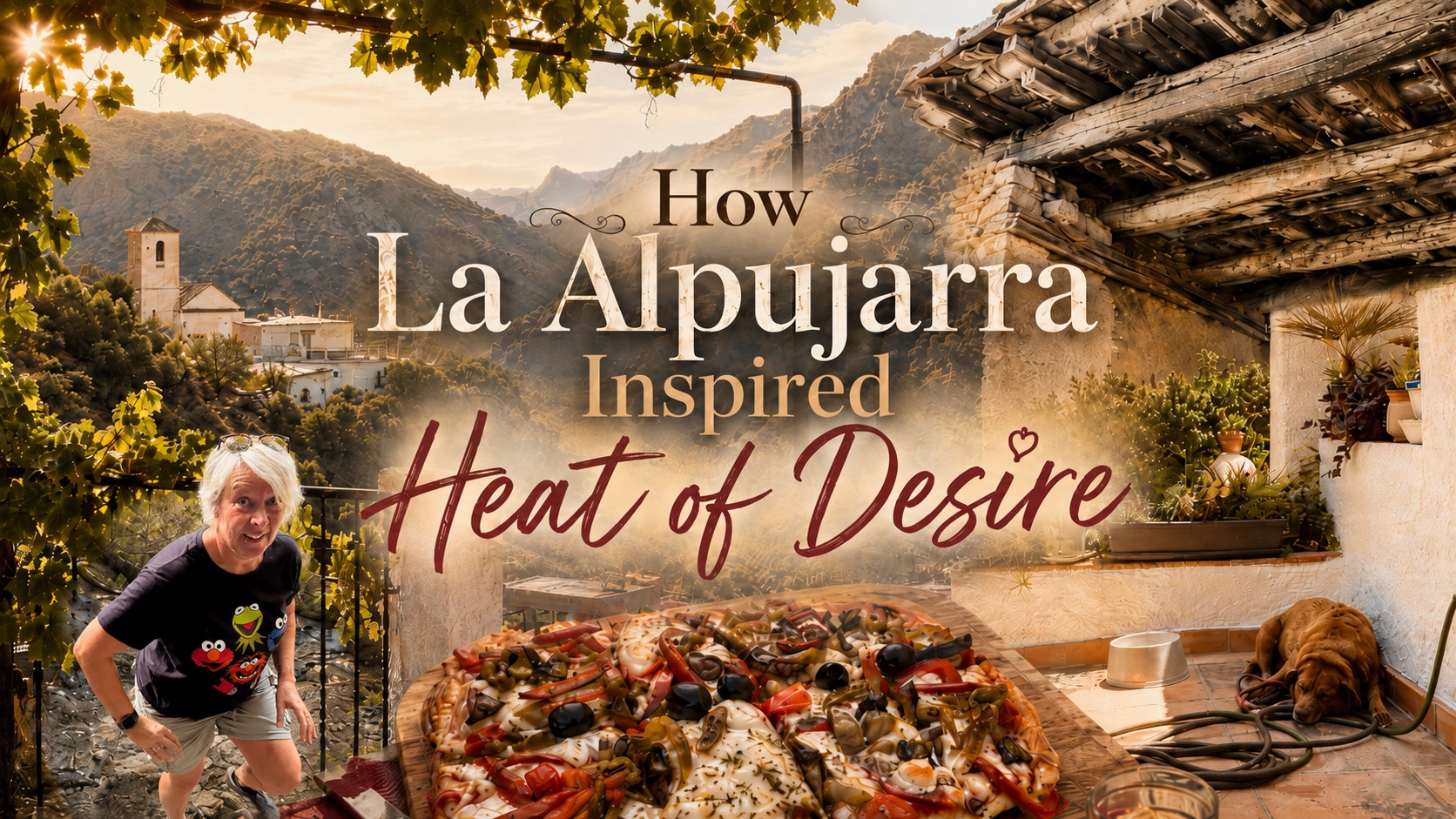
La Alpujarra is not the kind of place that shouts for your attention.
It does something much more dangerous.
It waits.
It lets the road twist higher into the mountains. It lets the white villages appear one by one against the slopes. It lets the heat settle on your skin, the scent of rosemary and dry earth drift through the air, and the silence gather around you until you realise how loud the rest of your life has become.
We visited in August 2025, after spending time in nearby Órgiva over the previous two years, and this time we based ourselves in Fondales, in La Taha. It was my husband, our two daughters, and our two dogs. Our son, sadly, was working, which I am still choosing to regard as noble rather than a terrible failure of family-holiday coordination.
Fondales was our base, but it was the wider Alpujarra that captured me.
There is something extraordinary about that landscape. The villages feel preserved rather than polished, lived in rather than staged. Whitewashed buildings, old stone, narrow lanes, shaded corners, sudden views, and water appearing like a small miracle just when the heat has started to win.
I loved how untouched it felt.
Not abandoned. Not frozen in time. Just protected from the frantic need to modernise everything until it loses its soul. So much of the built world now seems designed to impress quickly and age badly. La Alpujarra feels the opposite. It feels as if the mountains have allowed people to live there, but only on certain terms.
Even the buildings seem to belong to the landscape rather than sit on top of it.
And the roofs fascinated me. They are not the neat terracotta-tiled roofs many of us picture when we think of Andalusian villages. The traditional Alpujarran roofs are something much older and stranger: flat terraos built from timber beams, slate slabs, earth, and launa, a grey mineral clay used to seal and waterproof them. You can look up and see layers of trunks, stone, wire, shadow, age, and stubborn human ingenuity holding the whole thing together.
Frankly I am not sure how some of those buildings remain standing, but they do.
And somehow that makes them more wonderful.
You do not dominate a place like that.
You adapt to it.
That thought stayed with me.
The natural springs were one of my favourite discoveries. Cool, clear, mineral-rich water coming straight from the mountain, nourishing in a way that feels both ordinary and deeply luxurious. Not luxury as in marble lobbies and silent lifts. Luxury as in water, shade, air, space, and a path leading somewhere you have not yet been.
It is a wonderful place for walking. Some walks are gentle enough to pretend you are only going out for a little wander before lunch. Others remind you very quickly that mountains do not care how romantic your intentions are. Either way, nature is right there on your doorstep. Not arranged for your convenience. Not tidied into submission. Just present.
And for a writer?
Heaven.
The Alpujarra has the perfect ingredients for a writing retreat: peace, beauty, texture, history, heat, silence, and just enough wildness to make your imagination sit up and behave itself. I could have stayed there with a notebook for weeks.
Which, inevitably, meant part of my brain started building a story.
When I was shaping Heat of Desire, I knew Lucas de la Vega needed to be taken out of Madrid.
Lucas is a man of glass, steel, penthouses, private lifts, biometric locks, dashboards, controlled temperatures, controlled rooms, controlled outcomes. His world is high above the city, sealed away from noise and mess and anything he cannot manage.
La Alpujarra is the perfect opposite.
It is ancient where his world is new. Organic where his world is engineered. Earthy where his world is polished. Alive in a way no billionaire penthouse can ever be, no matter how beautiful the view.
And that made it the perfect place to challenge him.
In Madrid, Lucas can convince himself that control is safety. He can command rooms, companies, aircraft, lawyers, systems, schedules. But put him in the mountains, with heat in the air, smoke on the wind, stone underfoot, and a woman beside him who refuses to be managed?
Suddenly the rules change.
That was what inspired the setting for Heat of Desire. Not one single village copied onto the page, but the feeling La Alpujarra gave me: beauty with teeth, peace with power, a landscape that refuses to be owned.
It gave me the perfect environment for a ruthless, controlled billionaire to be stripped of his certainties.
The perfect place for Cami to see the man beneath the armour.
The perfect place for pressure, danger, desire, and truth.
And maybe that is why La Alpujarra stayed with me so strongly. It is not just beautiful. It changes the emotional temperature of a story. It makes people smaller in the best possible way. It reminds them they are human.
For Lucas, that is exactly what he needs.
A world he cannot control.
A woman he cannot command.
And a landscape wild enough to teach him the difference between power and trust.
The perfect place, in other words, for him to change.
And fall in love.