
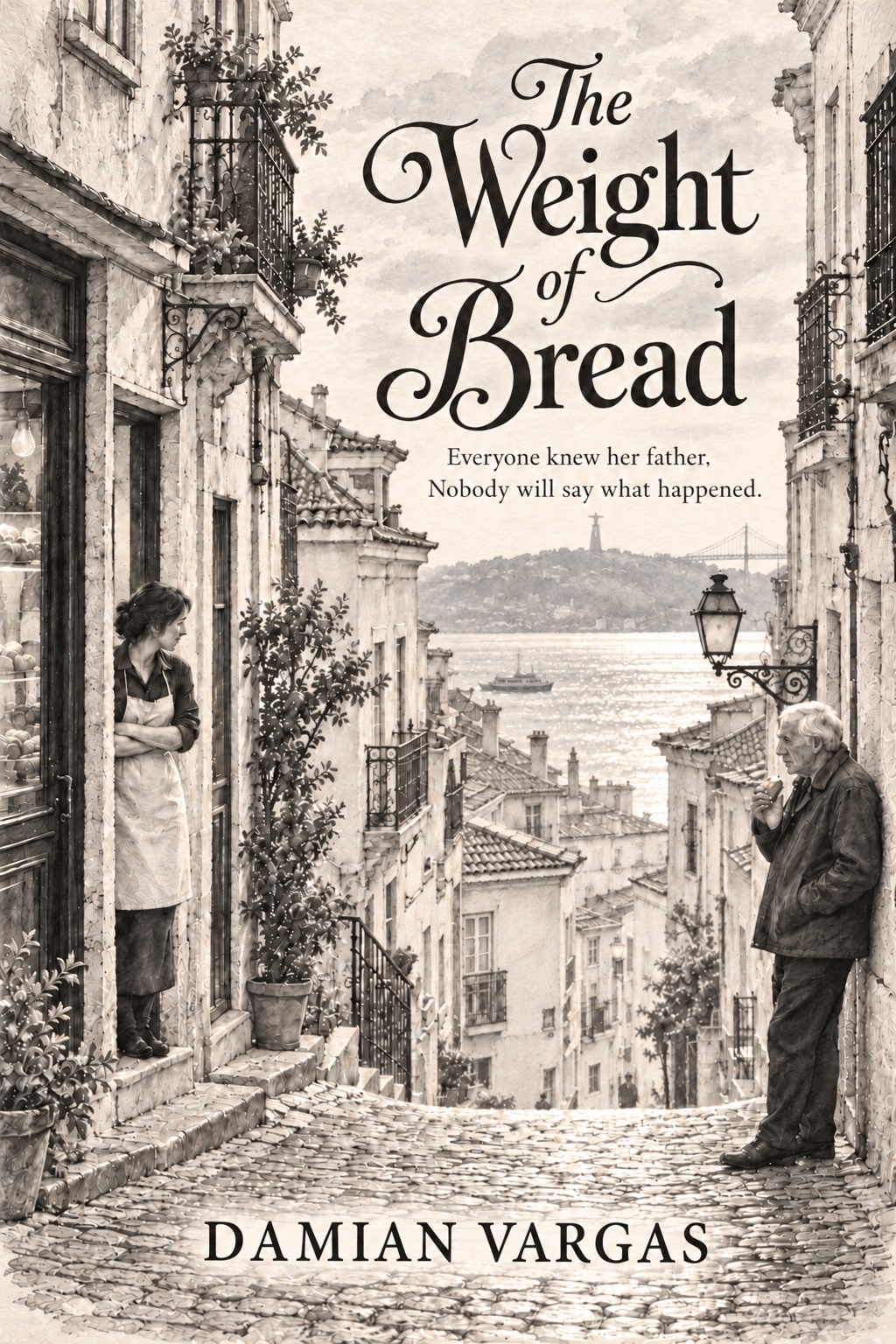
I fell in love with Lisbon on foot.
I like the Lisbon of the postcards and the tram queues too, but what caught me were the old streets of Alfama, where the city is at its oldest. History there isn’t something you read on a plaque. You feel it in the air, in the walls and in the cobbles under your feet, worn smooth by centuries of people climbing the same hills. Alfama is a maze. You get lost in it even when you think you know the way, and getting lost is half the pleasure. Somewhere on those walks, between the laundry strung across the alleys and the sound of a guitar through an open window, this book began.
It is a different kind of book for me. I have written thrillers, historical fiction, a comedy and science fiction, stories driven by danger, desire and big ideas. The Weight of Bread is my first attempt at a literary novella, and I’ll admit the idea frightened me a little. There is no villain here, no chase and no ticking clock. The biggest event in the opening chapter is a man eating a loaf of bread on the pavement. I wanted to find out whether a small story, told quietly, could keep a reader turning pages to the end. I hope it kept you.
Fado was always going to be at the heart of it. If you have never heard it, fado is Lisbon’s music: songs of longing, loss and fate, sung in small taverns late at night to the sound of the guitarra portuguesa. It is bound up with saudade, a word the Portuguese will tell you has no English translation. The nearest I can get is a longing for someone or something you have lost, or perhaps never had, that you would not give up even if you could. That feeling runs through every page of this book. So does an old Portuguese saying: quem canta seus males espanta, whoever sings scares away their sorrows. I’m not sure it’s true. I don’t think the book is sure either.
Then there is Mira’s gift. I didn’t want a superpower, or a mystery to be solved. I wanted something a woman might carry all her life and never mention to anyone: a glimpse of someone else’s life, caught as a loaf passes from one hand to another. I never explain it, because Mira can’t explain it either. It is simply part of her, like her hands.
And bread. It is the most ordinary thing in the world, made by hand before anyone else is awake, the same way every day. I love that a family bakery runs on routine, and that routine can carry people through years they might not otherwise have managed. The broa de milho Mira bakes every morning came down to her from her grandmother. The book is partly about what else comes down through a family along with the recipes.
Because most families have a story nobody tells. Sometimes the silence is cruel. More often, I think, it is meant as protection, and the people keeping it believe they are doing right. That is what interested me most. Not who is right, but what a silence kept for thirty years does to the people on either side of it. If this book leaves you thinking about a story in your own family that nobody talks about, it has done what I hoped.
A note on places. Rua dos Remédios, Rua de São Miguel, Largo de São Rafael and the Miradouro da Graça are all real, and all worth walking. Pastelaria Cardoso and Café Zacarias are my inventions, as are the people in them, so please don’t go looking for Mira behind a counter. “Sombra do Tejo” is invented too. “Canção do Mar” is very real and worth finding. There is a real Tasca do Chico in Lisbon, a much-loved fado bar, but it is in Bairro Alto, across the city. I borrowed its name and moved it to the foot of Rua de São Miguel because the story needed it there. I hope Lisbon will forgive me.
You will also have noticed that I left many Portuguese words untranslated: menina, broa, galão, saudade and others. That was deliberate. I wanted you to hear the neighbourhood as Mira hears it, and most of the words explain themselves as you go. I have provided a Glossary (the following section) in case you wish to look up any of the words.
Thank you. It means the world to me that you read this book. I have been making up stories for as long as I can remember, and having someone read one to the end is why I keep doing it.
Please help me by posting an honest review on the store where you bought this book, or on Goodreads. It will only take a few minutes, but it helps me more than I can say.
And do drop me a line by email, or find me on Facebook or Instagram, if you would like to tell me what you thought of this or any of my other books. I read every message.
Obrigado por ler. Thank you for reading.
Damian Vargas, October 2026